
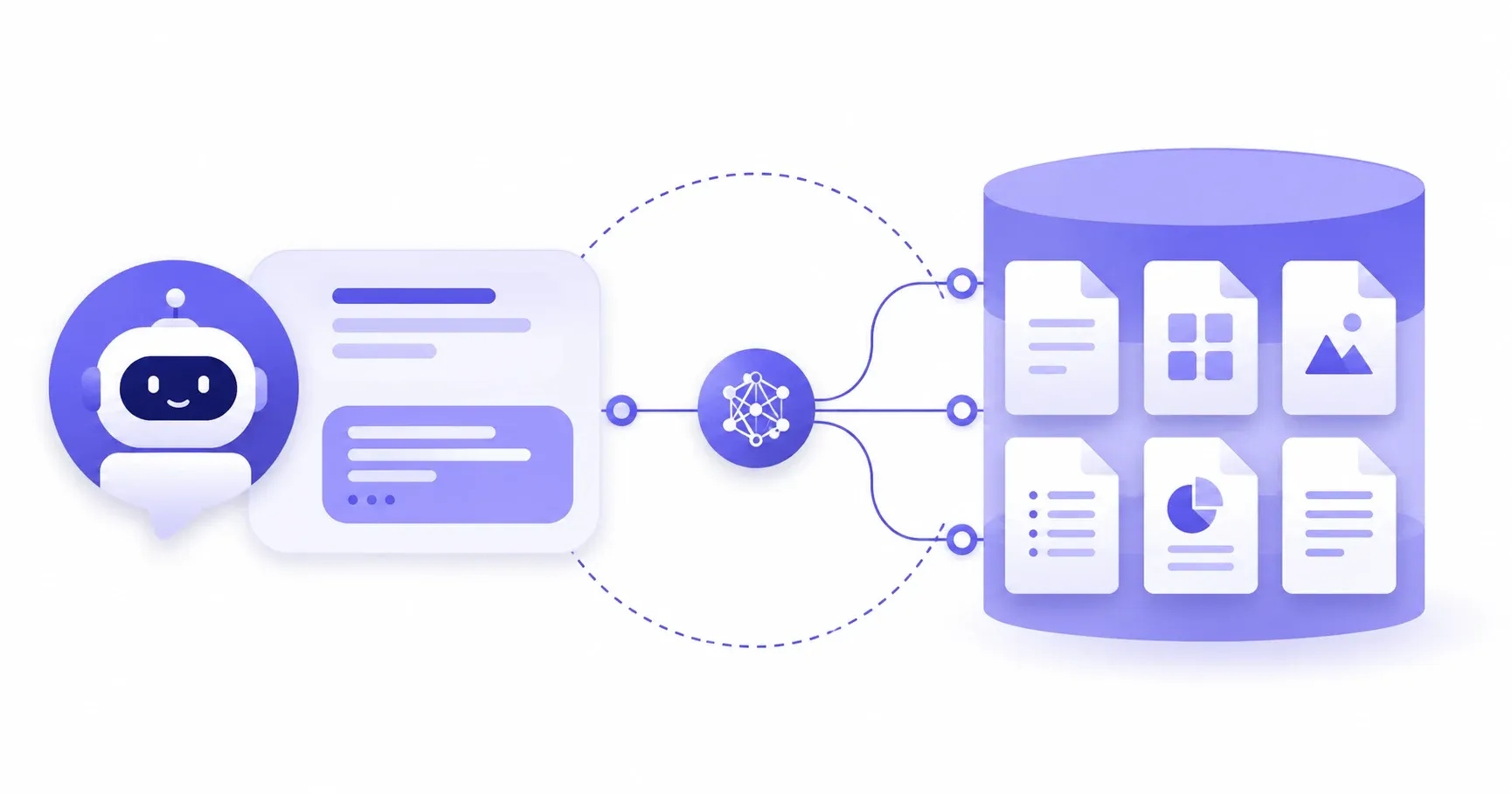
What is an AI chatbot agency and what does it do?
An AI chatbot agency designs, integrates and maintains conversational agents connected to your systems (CRM, document base, helpdesk), not a simple question-and-answer script.
Its role goes far beyond configuring a tool. A serious agency starts by scoping the use cases with the highest return, chooses the right language model, connects the bot to your business data securely, then handles maintenance and performance measurement. The difference with a classic rule-based chatbot is fundamental: where the old bot followed a rigid decision tree, the AI agent understands intent and answers in natural language.
In France, adoption is accelerating: according to Digitiz, 44% of companies use at least one AI tool in 2026, and 58% of B2B companies rely on chatbots for lead generation.
What criteria should you use to choose an AI chatbot agency?
Favour data and security expertise, not just mastery of the model: integration with your data is what makes or breaks a project.
| Criterion | Why it is decisive |
|---|---|
| RAG expertise | Avoids hallucinations, guarantees sourced answers |
| Connectors (SharePoint, CRM, PDF) | The bot uses your real data |
| Sovereign / on-premise hosting | GDPR compliance, sensitive data protected |
| Multi-channel and multi-LLM | Web, Teams, Slack, WhatsApp, with no lock-in |
| ROI measurement | Resolution rate, contact deflection |
| Maintenance | An agent lives and improves, it is not a one-off delivery |
Use this grid to compare the agencies you consult, including our AI chatbot agency. The following sections detail the criteria that make the difference.
Why require RAG expertise from an agency?
RAG (retrieval augmented generation) forces the chatbot to answer from your indexed documents rather than from its memory, which removes most hallucinations.
In practice, before generating an answer, the bot searches for the relevant passages in your base: FAQs, contracts, procedures, product sheets, support tickets. It then explicitly relies on these extracts. Three direct benefits:
- Reliability: sourced, traceable answers that match business reality. Essential in finance, healthcare, insurance or the public sector.
- Instant updates: changing a document updates what the bot knows, without retraining the model.
- Governance: on-premise deployment possible, access rights per profile, sensitive data that never leaves your systems.
A purely generative chatbot without RAG can invent a price, ignore a contract clause or give an outdated procedure. This is the approach of GuardWeaver, the AI governance platform published by Matvi: connecting AI to your business sources without exposing your data.
Which use cases should the agency be able to scope?
The most profitable uses are first-level customer support, internal assistance for employees and lead qualification.
In 2026, around 80% of predictable support conversations (repetitive questions) can be handled autonomously by a chatbot, according to Digitiz. Concrete examples:
- Customer support: 24/7 answers on orders, billing and after-sales service, with escalation to a human when needed.
- Internal assistance: an employee queries HR, IT or quality procedures in natural language.
- Pre-sales: qualifying prospects and directing them to the right contact.
How do you judge the cost and ROI announced by an agency?
Well-supported companies report an average return of 8 euros for every euro invested, and 57% see a significant ROI in the first year.
The cost depends on the scope: number of connected sources, channels, volume of interactions, level of customisation. But the gains are measurable and quick. According to Botpress, a well-sized chatbot reaches its ROI in 3 to 6 months when it is connected to business systems. Conversational AI can cut customer service costs by up to 30%, and the return of 8 euros for every euro invested comes from a 2026 comparison of enterprise AI chatbots.
On the usage side, 62% of users prefer a chatbot to waiting for an agent ( Digitiz), and the global conversational AI market reached 14.79 billion dollars in 2025 ( Fortune Business Insights).
Which mistakes does a good agency help you avoid?
Failures rarely come from the technology: they come from a poorly defined scope, unprepared data or a lack of measurement.
- Trying to automate everything at once: start with one high-volume, high-return use case.
- Neglecting data quality: a bot connected to an outdated base will give outdated answers.
- Forgetting human escalation: the bot must know when to hand over.
- Not measuring: without resolution and satisfaction indicators, there is no way to improve.
How does Matvi design custom AI chatbots?
Matvi publishes GuardWeaver and deploys AI agents connected to your data, as SaaS or on-premise, with a dedicated contact.
Our method: scope the use case with the highest return, connect your business sources through RAG, choose the hosting that fits your GDPR constraints (including sovereign cloud), then measure and improve continuously. Discover our AI chatbot agency offer and our no-code and AI solution to automate your processes.
Need a reliable AI chatbot connected to your data? Let’s talk about your project.
Frequently asked questions
Can an AI chatbot make mistakes?
With a well-designed RAG architecture, the bot answers from your documents and cites its sources, which greatly reduces errors.
Is my data exposed?
Not if the deployment is sovereign or on-premise: the data stays in your systems and is queried through secure connectors.
How long does a project take?
A first agent connected to your sources can be operational within a few weeks, depending on the scope.
Does it replace human teams?
No: the chatbot handles repetitive requests and leaves the high-value cases to your teams.
Sources
- Digitiz, AI statistics (in French) (opens in a new tab) (accessed on )
- Botpress, the ROI of chatbots (in French) (opens in a new tab) (accessed on )
- Fortune Business Insights, conversational AI market (in French) (opens in a new tab) (accessed on )
- Smart IT Training, the best AI chatbot for businesses (in French) (opens in a new tab) (accessed on )

About the author
Mathieu Perochon
Co-founder · cloud, DevOps, cybersecurity
Cloud expert, systems engineer, DevOps and software developer. Engineer specialised in cybersecurity, SecNumEdu-certified by ANSSI. Over twelve years, he has worked with American and French companies on highly strategic cloud projects.