
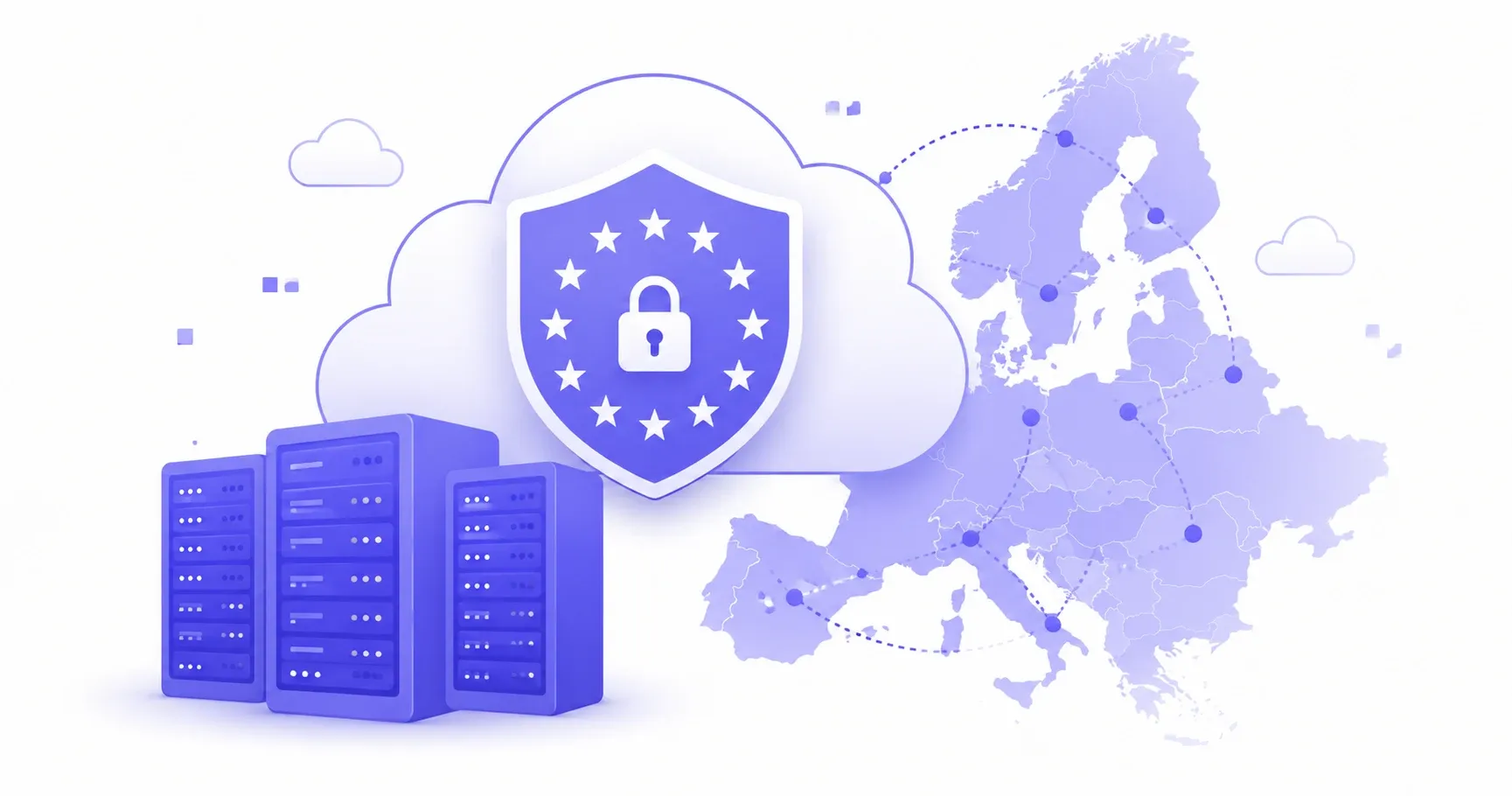
What is sovereign cloud?
Sovereign cloud refers to hosting whose data, operations and ownership remain in Europe, out of reach of foreign extraterritorial laws.
It addresses two issues: GDPR compliance and legal independence. In 2026, 65% of French managers consider digital sovereignty a major issue. The movement is also institutional: in 2025, the French State directed 70% of its 84 million euros of cloud orders to European providers, and in 2026 the European Commission awarded a 180 million euro framework contract to four sovereign cloud consortia.
Sovereign cloud or public cloud: what is the difference?
The classic public cloud (AWS, Azure, Google) offers flexibility and scale but remains subject to US law; sovereign cloud guarantees where the data is located and its legal protection.
The difference is not primarily technical, it is legal. A public cloud can be hosted in a European data centre and still be accessible to US authorities, because the operator is a company governed by US law. Sovereign cloud adds European governance and control guarantees. The concrete choice between players such as OVH and IONOS is covered in our OVH or IONOS comparison.
What are the concrete benefits of sovereign cloud?
Beyond compliance, sovereign cloud brings legal protection, local support and easier reversibility, without sacrificing performance.
- Protection from extraterritorial laws: your data escapes the Cloud Act and its access requests.
- Built-in GDPR compliance: data located and processed in Europe.
- French-speaking, local support: contacts and invoicing in French.
- Equivalent performance: sovereign providers reach 96 to 98% of the hyperscalers’ performance.
- Reversibility: less dependence on a closed ecosystem.
Why does the Cloud Act threaten your data?
The US Cloud Act (2018) allows US authorities to access data held by an American company, even when hosted in Europe, with no mandatory notification.
For an SME or a mid-cap, the risk is twofold: exposure of sensitive data and a risk of GDPR non-compliance. Regulation is tightening: the CNIL imposed 486.8 million euros in fines in 2025, nine times more than in 2024. Choosing where to host your data is therefore no longer just a technical question, but one of legal risk management.
What is the SecNumCloud qualification?
SecNumCloud is the ANSSI qualification that guarantees sovereign hosting: European headquarters and control, strict GDPR compliance and resistance to extraterritorial laws.
In March 2026, the ANSSI catalogue listed 9 qualified SecNumCloud 3.2 offers (OVHcloud, Numspot, S3NS, etc.). The qualification requires predominantly European ownership (no more than 24% held individually by a non-EU player) and reinforced security audits, as explained in this SecNumCloud guide. For an SME, aiming for SecNumCloud is not always mandatory, but it is the reference standard for sensitive data.
Which sectors are most concerned?
Healthcare, finance, the public sector, the defence industry and the legal professions are the most exposed to sovereignty requirements.
These sectors handle sensitive or strategic personal data, often subject to specific regulatory obligations: health data hosting (HDS), professional secrecy, data of operators of vital importance. But any SME holding customer data, contracts or intellectual property has an interest in assessing its exposure, even without a formal legal obligation.
What is the link between sovereign cloud and AI?
Deploying an AI agent or a chatbot on a sovereign cloud lets you use your business data without exposing it to foreign models or hosts.
The rise of generative AI changes the game: a chatbot connected to your documents (RAG architecture) processes potentially sensitive data. Hosting it on a sovereign cloud, or even on-premise, guarantees confidentiality. This is why the choice of hosting is inseparable from an AI project, as we explain in our guide to choosing an AI chatbot agency.
What are the obstacles and misconceptions?
The two classic objections, high prices and lower performance, no longer hold up against today’s European offers.
Standard European cloud remains competitive with the hyperscalers; only premium SecNumCloud offers are more expensive, and for good reasons (audits, guarantees). On performance, the gap has narrowed to 2-4% on compute and storage. The real obstacle is often the migration, which is handled with a step-by-step plan.
How do you migrate to a sovereign cloud?
A successful migration follows four steps: an audit of data and flows, the choice of a European host, a gradual migration, then managed services.
- Audit: map sensitive data and technical dependencies.
- Choice of host: OVH, IONOS or a SecNumCloud provider, depending on requirements.
- Migration in batches: no service interruption, starting with the least critical workloads.
- Managed services: continuous supervision and security through a managed services provider.
Depending on the scope, a migration takes from a few weeks for an SME to several months for a mid-cap with interconnected applications.
Matvi supports your transition from audit to production. Discover our sovereign cloud offer or let’s talk about your project.
Frequently asked questions
Is sovereign cloud more expensive?
SecNumCloud offers are premium, but standard European cloud remains competitive with the hyperscalers.
Do you have to migrate everything?
No: sensitive data comes first, the rest can follow gradually.
Is SecNumCloud mandatory?
Only for some government data and regulated sectors; for an SME, it is a security guarantee, not a general obligation.
Do you lose performance?
No, sovereign providers reach 96 to 98% of the performance of the American hyperscalers.
Sources
- Skuria, digital sovereignty, a definition (in French) (opens in a new tab) (accessed on )
- Vertical Expense, sovereign cloud and mid-caps in 2026 (in French) (opens in a new tab) (accessed on )
- Nymphar, digital sovereignty for SMEs and mid-caps (in French) (opens in a new tab) (accessed on )
- Scalingo, guide to the SecNumCloud qualification (in French) (opens in a new tab) (accessed on )

About the author
Mathieu Perochon
Co-founder · cloud, DevOps, cybersecurity
Cloud expert, systems engineer, DevOps and software developer. Engineer specialised in cybersecurity, SecNumEdu-certified by ANSSI. Over twelve years, he has worked with American and French companies on highly strategic cloud projects.