
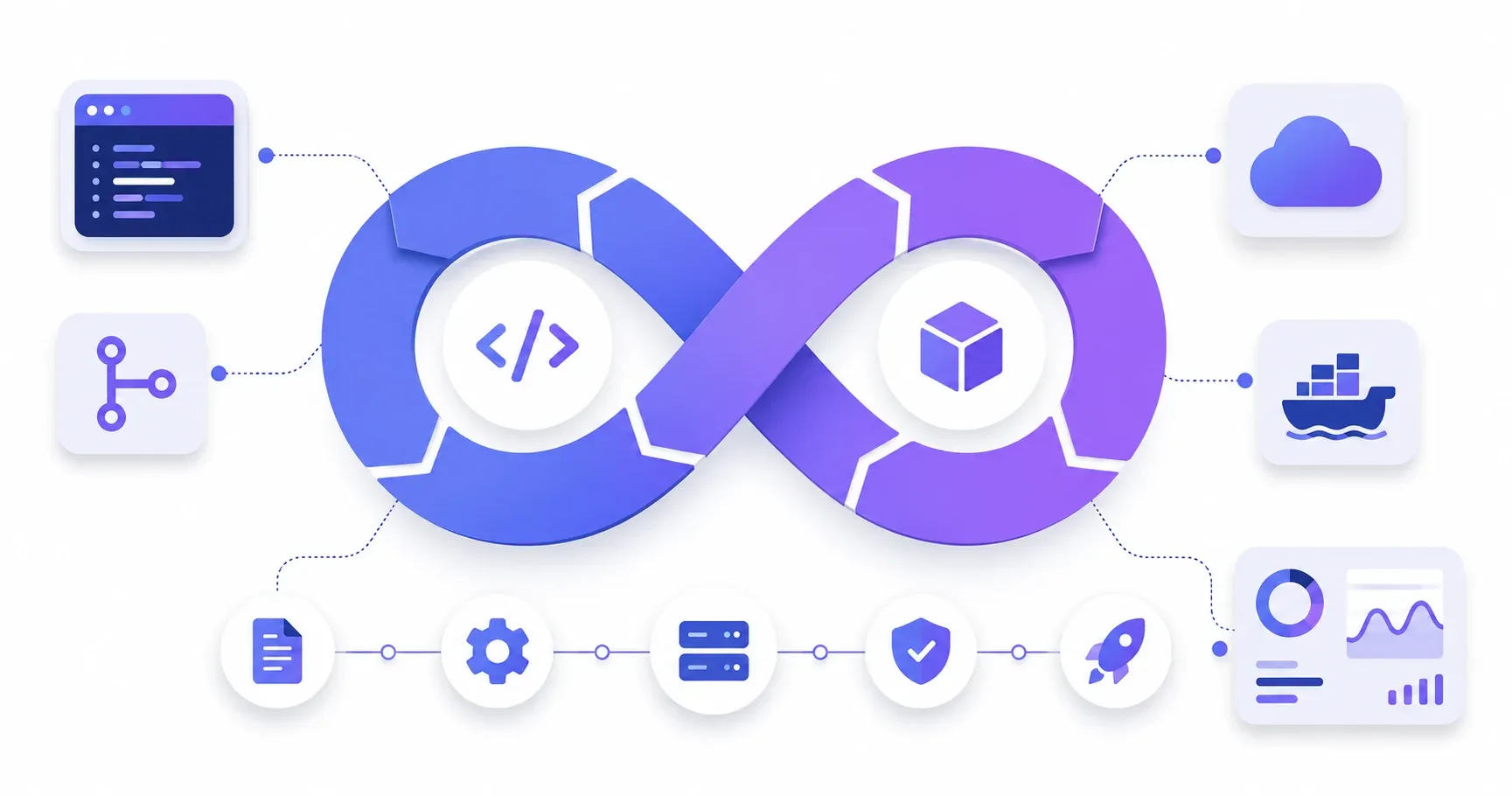
What is DevOps?
DevOps is a culture and a set of practices that bring development and operations together to deliver software faster and more safely.
In practice, it relies on continuous integration and deployment (CI/CD), infrastructure as code, test automation and supervision. The goal: shorten the cycle between an idea and its release to production, without sacrificing reliability. DevOps is not just tooling; it is first and foremost an organisation that removes the silos between teams.
What concrete gains can you expect from DevOps?
More than 70% of companies that have adopted DevOps report a faster time to market, and the best teams deploy far more often with fewer incidents.
According to the DORA metrics, elite teams deploy 182 times more frequently than the lowest-performing teams. Company case studies show a 60% reduction in incidents thanks to automated testing, and more than 70% of companies see a faster time to market.
What are the 4 DORA metrics?
The 4 DORA metrics measure a team’s performance: deployment frequency, lead time for changes, change failure rate and time to restore service.
- Deployment frequency: how often you release to production.
- Lead time for changes: time between a commit and its release to production.
- Change failure rate: share of deployments that cause an incident.
- Time to restore service (MTTR): how quickly you restore service after an outage.
Only 19% of teams were rated elite in 2024, which leaves huge room for improvement for most organisations.
DevOps, DevSecOps, platform engineering: what are the differences?
DevSecOps builds security in from the design stage, and platform engineering industrialises DevOps through self-service platforms.
This is not a passing trend: Gartner predicts that 80% of large software engineering organisations will have a platform engineering team by 2026, up from 45% in 2022. DevSecOps, for its part, responds to growing security and compliance requirements.
Why outsource your DevOps?
DevOps requires rare skills (CI/CD, cloud, security, observability); outsourcing gives you access to this expertise without hiring a full team.
For an SME or a mid-sized company, building a DevOps chain in-house is slow and expensive. A partner brings best practices right away and avoids structural mistakes (fragile pipelines, technical debt). The DevOps market reflects this trend: it is expected to grow from 8.91 to 40 billion dollars between 2024 and 2032.
Which DevOps mistakes should you avoid?
DevOps failures come mostly from culture, not tooling: lingering silos, automation without tests, no measurement.
- Automating without testing: shipping bugs faster is not progress.
- Ignoring measurement: without DORA metrics, you cannot improve.
- Keeping the silos: tools do not replace collaboration between teams.
- Neglecting security: adding it late costs more (hence DevSecOps).
How does a DevOps engagement with Matvi work?
An audit of the existing setup, CI/CD and infrastructure as code, test automation, then supervision and continuous improvement.
We industrialise your deployments and secure your delivery chain. Discover our DevOps offer and our managed services for day-to-day operations.
What is the link between DevOps and the cloud?
DevOps relies heavily on the cloud: 76% of teams use a public cloud and container orchestration such as Kubernetes.
DevOps practices deliver their full value on a scalable cloud infrastructure, often orchestrated by Kubernetes and deployable on a sovereign cloud for sensitive data.
Want more reliable deployments? Let’s talk about your DevOps chain.
Frequently asked questions
Is DevOps only for large companies?
No, SMEs benefit greatly from it thanks to automation and fewer incidents.
Should you automate everything at once?
No, start with CI/CD and testing, then expand step by step.
How long before you see results?
The first gains (more frequent deployments) appear within a few weeks.
Are DevOps and Agile the same thing?
No: Agile structures development, while DevOps extends agility all the way to production and operations.
Sources
- Deviniti, 40 DevOps stats for 2026 (opens in a new tab) (accessed on )
- Syslearn, DevOps as a new culture in companies (in French) (opens in a new tab) (accessed on )
- Inventiv IT, DevOps (in French) (opens in a new tab) (accessed on )
- Market Research Future, DevOps market (in French) (opens in a new tab) (accessed on )

About the author
Mathieu Perochon
Co-founder · cloud, DevOps, cybersecurity
Cloud expert, systems engineer, DevOps and software developer. Engineer specialised in cybersecurity, SecNumEdu-certified by ANSSI. Over twelve years, he has worked with American and French companies on highly strategic cloud projects.