
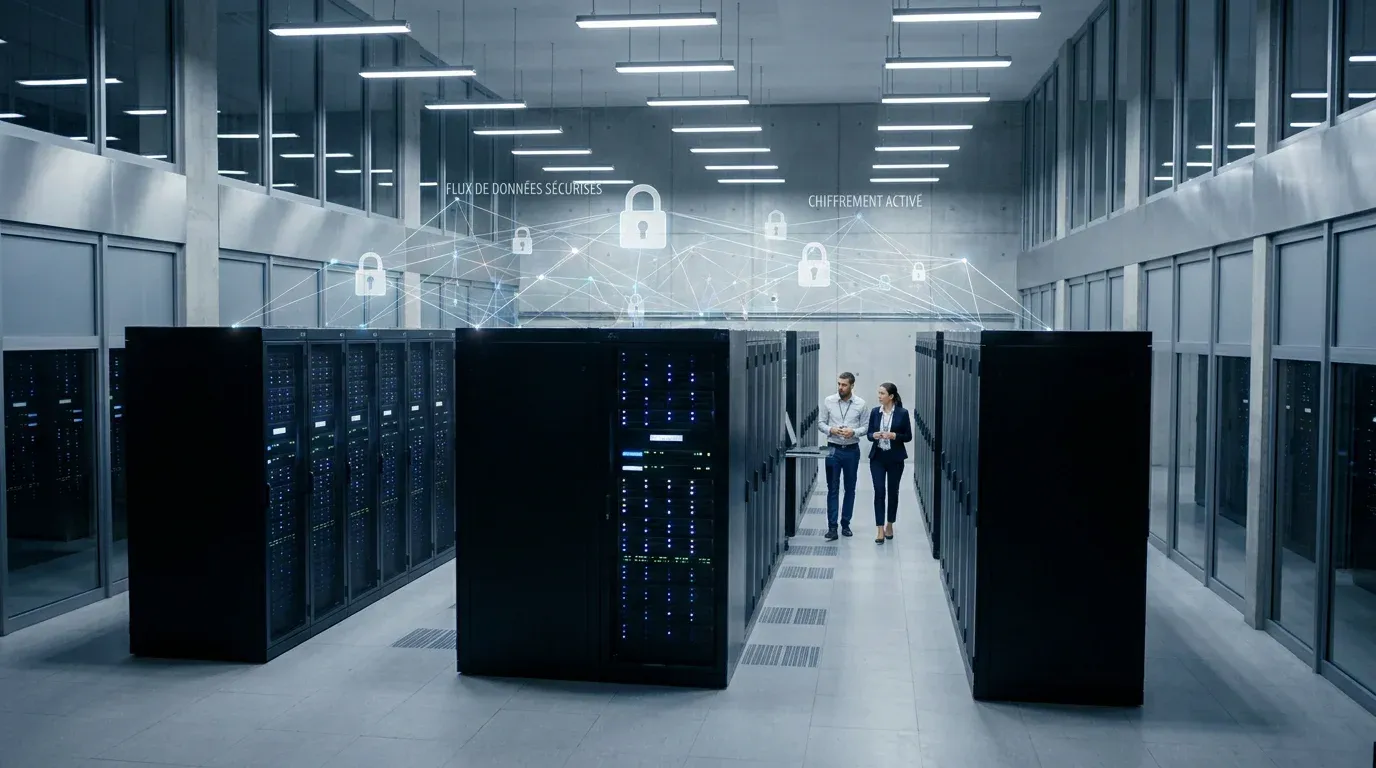
In 2026, French CEOs are making AI a strategic priority, more demanding than cautious, aiming for transformation, governance and value creation. Yet most AI pipelines still rely on APIs and infrastructure hosted outside Europe, exposing sensitive data to foreign jurisdictions. Sovereign RAG addresses exactly this tension: harnessing the power of large language models while keeping full control over your information assets. For organisations that want to structure this approach, Matvi, an AI chatbot agency, offers a proven framework, from document audit to production.
But what does a retrieval-augmented generation architecture deployed in France, on compliant infrastructure, actually involve? What are the essential technical building blocks, the measurable operational gains and the mistakes to avoid? This article gives you the keys to make an informed decision.
What is RAG and why make it sovereign?
Retrieval-Augmented Generation connects a language model to your internal document base. Rather than answering from generic knowledge, the LLM relies on your contracts, procedures and reports to produce contextualised, verifiable answers. The result: fewer hallucinations, more reliability.
Making this architecture sovereign means that the whole chain (ingestion, vectorisation, storage, inference) runs on infrastructure located in France or Europe, compliant with the GDPR and current regulations. The European AI Act, which entered into force in 2024, strengthens traceability and data location requirements for high-risk AI systems. For French companies, a RAG hosted on European infrastructure is no longer just a competitive advantage; it is a compliance prerequisite for some sectors.
In practice, this removes the risk of a foreign provider accessing your data under extraterritorial legislation such as the US Cloud Act, while guaranteeing an auditable framework for your stakeholders.
A fast-growing sovereign cloud market
According to Gartner, spending on sovereign cloud services will reach 80 billion dollars in 2026, up 35.6% on 2025. In Europe, the sovereign cloud services market is expected to grow from more than 20 billion euros in annual revenue in 2025 to more than 100 billion euros by 2031, according to Broadcom’s projections. These figures, reported by Tech Insider, show a clear trajectory: data sovereignty is no longer a theoretical concept but a fast-growing budget line.
In France, the momentum is even stronger. OVHcloud passed the symbolic mark of one billion euros in annual revenue in 2025, with 1,084.6 million euros of revenue, up 9.3% year on year. Players such as Scaleway or OUTSCALE (Dassault Systèmes) are strengthening their SecNumCloud-qualified offers, creating an ecosystem that favours the deployment of sovereign RAG pipelines.
France had 1,000 AI start-ups in 2025, versus 502 in 2021, and ranked 5th worldwide in the Global AI Index 2024. The 109 billion euros announced at the Paris AI Summit in 2025 include a major component on sovereign infrastructure and European foundation models. The ground is therefore prepared for French companies to deploy RAG architectures on solid, compliant and high-performing foundations.
The technical building blocks of a sovereign RAG architecture
Building a sovereign RAG pipeline means assembling four key components, each of which must meet location and compliance requirements.
Document ingestion and chunking
Your documents (PDF, Word, emails, SharePoint bases) are collected and then split into semantic segments called chunks. The quality of this step directly determines the relevance of the answers. Chunks that are too coarse drown the context; chunks that are too fine fragment it.
Vectorisation and storage
Each segment is converted into a numerical vector by a locally hosted embeddings model (for example Mistral or open-source models). These vectors are stored in a sovereign vector database. The Scalingo for OpenSearch service, available since June 2025, is based on the open-source OpenSearch engine (Apache 2.0 licence) and makes it possible to deploy vector search engines in an ISO 27001 and HDS certified environment. Other options such as pgvector on PostgreSQL offer a pragmatic alternative for teams that already run this database.
Semantic search and reranking
When a user submits a query, it is vectorised and then compared with the stored vectors to identify the most relevant passages. Advanced systems combine hybrid search (semantic and keyword) with a reranking mechanism to refine the selection before passing it to the LLM.
Inference by a local or European LLM
The language model receives the query enriched with the document context and produces an answer based exclusively on your data. Models such as Mistral or Llama, deployed on European infrastructure (OVHcloud, Scaleway, IONOS), ensure that no data passes through extraterritorial servers.
Use cases: where sovereign RAG creates the most value
Feedback from the field in France shows that some departments gain an immediate advantage from an AI assistant connected to internal documents.
Technical support and customer service. An AI chatbot fed with technical documentation resolves level 1 requests without human intervention. Resolution times go down and customer satisfaction goes up.
Human resources. Employees ask an assistant about leave policies, benefits or internal procedures. The HR department is freed from recurring questions and can focus on higher-value tasks.
Legal and compliance. Contract analysis, regulatory watch and clause checking become almost instantaneous. In regulated sectors, the ability to prove the origin of every piece of information is a non-negotiable requirement.
Industrial operations. Operators access safety procedures, maintenance sheets and quality standards directly from their workstation, improving safety and operational efficiency.
How to succeed with your sovereign RAG project in five steps
A successful deployment depends less on technological complexity than on methodological rigour. Here are the five key phases.
| Phase | Objective | Indicative duration |
|---|---|---|
| 1. Scoping | Identify the priority use case, audit the document corpus, define the KPIs | 2 to 3 weeks |
| 2. Data preparation | Clean, structure and segment the documents; enrich the metadata | 3 to 4 weeks |
| 3. Architecture and stack | Choose the LLM, the vector database, the embeddings model and the cloud infrastructure | 2 weeks |
| 4. Deployment and testing | Integrate the pipeline, evaluate relevance (RAGAS metrics), iterate | 4 to 6 weeks |
| 5. Training and continuous improvement | Train users, set up performance tracking and the feedback loop | Ongoing |
The most critical step remains corpus preparation. A RAG system cannot make up for outdated, duplicated or poorly structured data. It is a knowledge management project before it is a technology project.
The AI Act and choosing a provider
The European AI Act imposes transparency and data governance requirements that favour sovereign cloud solutions. Companies using AI models hosted on non-sovereign clouds could find it hard to demonstrate regulatory compliance. In this context, choosing a provider is not just a technical matter.
Sovereign RAG vs RAG on a public cloud: a comparison
To clarify the trade-offs, here is a summary comparison of the two approaches.
| Criterion | Sovereign RAG (Matvi / French infrastructure) | RAG on a US public cloud |
|---|---|---|
| Data location | France / EU, GDPR and AI Act compliant | US servers, subject to the Cloud Act |
| Certifications | SecNumCloud, ISO 27001, HDS possible | SOC 2, ISO 27001 (US scope) |
| Available models | Mistral, Llama, open-source models | GPT-4, Claude, proprietary models |
| Dependency risk | Low (open-source stack, portability) | High (vendor lock-in) |
| Support | From audit to production, human follow-up | Standard technical support |
| Entry cost | Moderate initial investment, controlled costs | Pay-as-you-go, variable costs |
The raw performance of proprietary models can be slightly higher on some generic tasks. But for business use cases based on your own documents, the quality of the retrieval pipeline (chunking, embeddings, reranking) matters more than the size of the model. A well-designed sovereign RAG easily rivals public cloud solutions in terms of relevance.
In France, according to the Kyndryl Cloud Readiness report published in 2025, 75% of business leaders cite the geopolitical risks of global clouds as a major concern. This statistic, reported by Tech Insider, confirms that the sovereign choice goes beyond the regulatory argument: it is also a matter of strategic resilience.
Sovereign RAG is emerging as the safest way to turn your document assets into a competitive advantage, with no compromise on compliance or security. European spending on sovereign cloud infrastructure will triple between 2025 and 2027 according to Gartner estimates published in February 2026; companies that invest in this architecture now will get a head start. With support covering the whole cycle, from the initial audit to managed services in production, you secure every step of your project. To assess what a RAG pipeline can concretely bring to your organisation, discover our AI chatbot agency support and plan a first scoping session.
Frequently asked questions
How long does it take to deploy a sovereign RAG?
The duration depends on the size of the corpus and the complexity of the integration. On average, allow 8 to 16 weeks for a first operational use case. Data preparation usually accounts for half of the schedule.
Is sovereign RAG compatible with my existing tools?
Yes. A RAG pipeline integrates with your business tools (CRM, intranet, SharePoint, document bases) through dedicated connectors. At Matvi, we design the architecture so that it fits into your ecosystem seamlessly, with transparent follow-up at every step.
What is the difference between fine-tuning and RAG?
Fine-tuning retrains a model on your data, which is costly and freezes knowledge at a given point in time. RAG, on the other hand, queries your documents in real time: a simple update of the corpus is enough to refresh the answers, with no retraining.
Sources

About the author
Mathieu Perochon
Co-founder · cloud, DevOps, cybersecurity
Cloud expert, systems engineer, DevOps and software developer. Engineer specialised in cybersecurity, SecNumEdu-certified by ANSSI. Over twelve years, he has worked with American and French companies on highly strategic cloud projects.